
FACT SHEET
Nebraska's First-Time Homebuyer Savings Account Act
On April 10, 2026, Nebraska lawmakers approved State Treasurer Joey Spellerberg’s First-Time Homebuyer Savings Account Act to help more Nebraskans save for their first home and put down roots in their community. The Act was included as the lead provision in LB 803, the Revenue Committee’s priority package, which passed 48-1. The governor signed LB 803 on April 16, 2026.
The Act was introduced on behalf of Treasurer Spellerberg by Senator Bob Hallstrom and prioritized by Senator Jared Storm. Co-sponsors were Senators Teresa Ibach, Carolyn Bosn, Tony Sorrentino, Barry DeKay, Dave Murman, Loren Lippincott, Bob Andersen, Brian Hardin, John Cavanaugh, Robert Dover, Eliot Bostar, Danielle Conrad, Dave Wordekemper, Kathleen Kauth, Jared Storm, Victor Rountree, and Jason Prokop.
Why the Act Is Needed
- • Nebraska’s median home price has surged from $155,000 a decade ago to around $290,000 today. The National Association of REALTORS® reports that the average age of a first-time homebuyer has climbed to a record 40 years old, compared to 30 years old in 2010.
- • The Act encourages prospective homebuyers to begin saving earlier by rewarding consistent, long-term savings with valuable state tax benefits. The Act will help first-time buyers save for down payments and closing costs, two of the biggest barriers to homeownership.
Definitions
- • First-time homebuyer: Someone who has never owned a primary residence or who, following the dissolution of a marriage, has not been listed on a property title for at least three consecutive years.
- • Qualified beneficiary: A first-time homebuyer designated by the account holder who will use the funds for eligible expenses.
- • Eligible expenses: Down payments and closing costs (e.g., appraisal fees, mortgage origination fees, inspection fees) tied to the purchase or construction of a primary residence in Nebraska.
How the Accounts Will Work
- • Opening an Account:
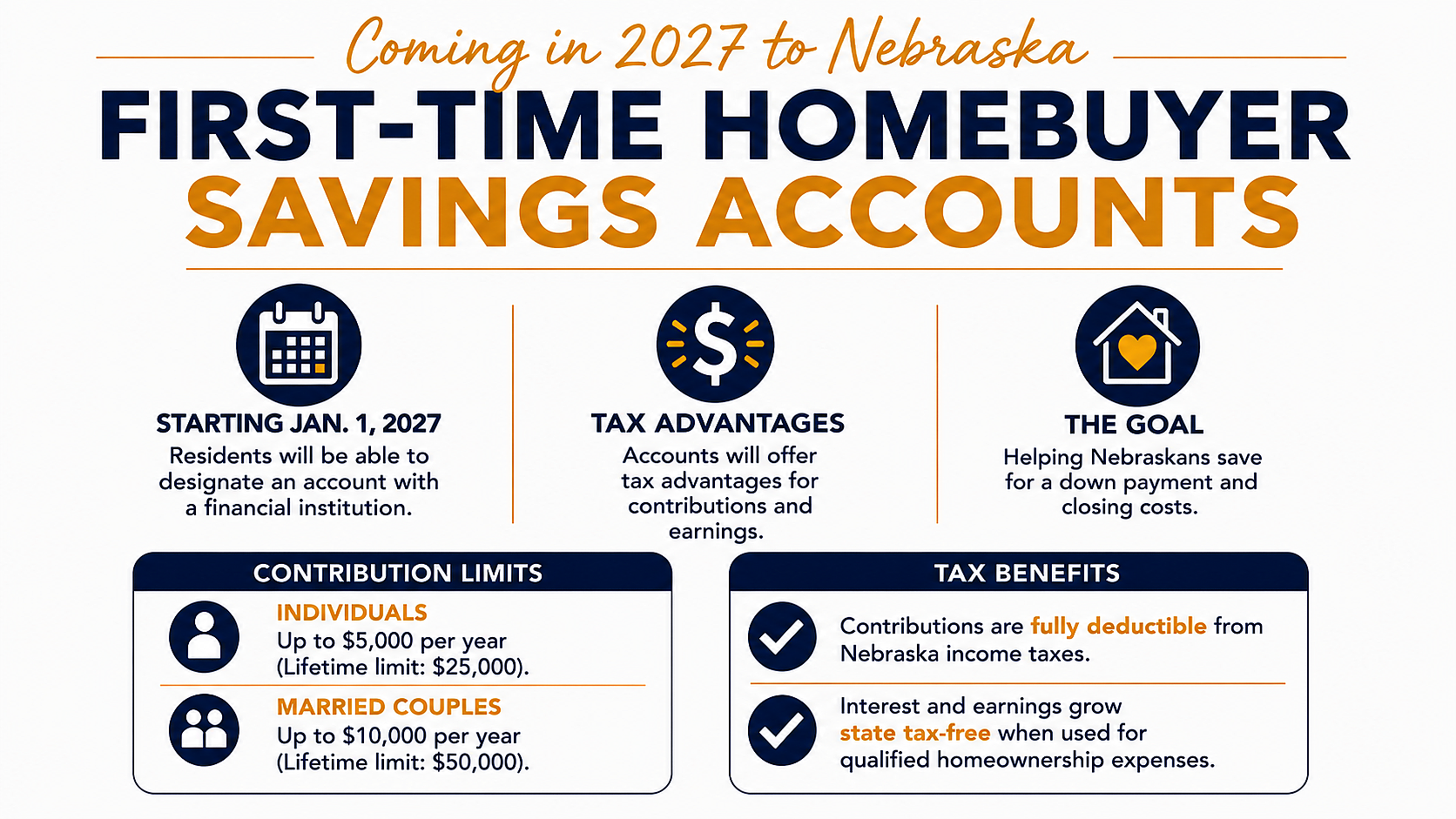
- - Starting January 1, 2027, individuals can open a First-Time Homebuyer Savings Account with a bank, credit union, or other qualified financial institution.
- - Accounts may be used to pay for or reimburse a qualified beneficiary's eligible expenses for the purchase or construction of a primary residence in Nebraska. (Section 5 of LB 803.) For active-duty military personnel who were stationed in Nebraska, funds can be used for eligible expenses in or outside the state.
- - An individual may be the account holder of multiple First-Time Homebuyer Savings Accounts, and an individual may jointly own the account with another person if they file a joint income tax return.
- - An account holder must designate, no later than April 15 of the year following the taxable year during which the account is established, a first-time homebuyer as the qualified beneficiary. Account holders can designate themselves as the qualified beneficiary.
- • Naming Beneficiaries/Transferring Funds:
- - Account holders can change the designated qualified beneficiary at any time, but there cannot be more than one qualified beneficiary at any time.
- - An account holder cannot have multiple accounts with the same qualified beneficiary, but an individual may be designated as the beneficiary of multiple accounts. (Example: John Doe could be the beneficiary of an account owned by a parent, and an account owned by a grandparent, and an account held by an aunt or uncle.)
- - Funds in an account may be transferred to another newly created First-Time Homebuyer Savings Account.
- • Contribution Limits:
- - Individuals: Up to $5,000 per year (Lifetime limit: $25,000).
- - Married Couples: Up to $10,000 per year (Lifetime limit: $50,000).
- • Tax Benefits:
- - Contributions are fully deductible from Nebraska income taxes.
- - Interest and earnings grow state tax-free when used for qualified expenses.
- - Funds can remain in the account indefinitely without penalty or recapture if eligibility requirements are met.
- • Qualified Expenses:
- - Funds may be used for down payments, closing costs, inspection fees, appraisal fees, and mortgage origination fees when purchasing a home in Nebraska — or for down payments and financing costs associated with constructing a primary residence in Nebraska. (Section 5 of LB 803.)
- • Reporting Obligations:
- - Account holders are responsible for maintaining documentation supporting eligible expenses and compliance with the Act. The Nebraska Department of Revenue will establish a form for account holders to report information, including how funds from the account are used.
- - An account holder must file with their state income tax return the completed form, the 1099 form for the account issued by the financial institution, and any other necessary documentation.
- - Financial institutions are not required to track how funds withdrawn from a First-Time Homebuyer Savings Account are used or report any information that is not otherwise required by law. Also, financial institutions are not liable for determining eligibility for tax benefits. (Section 7 of LB 803.)
- • Guardrails:
- - To prevent misuse, tax benefits can be recaptured if funds are withdrawn less than a year after the first deposit or are used for non-eligible purposes. Additional financial penalties could be applied if funds are used for non-qualifying purposes. (Section 5, Subsection 3 of LB 803.)
Estimated Tax Savings
Example 1: Single Nebraskan earning an annual income of $70,000, assuming:
- • He/she maximizes the annual savings limits, saving $25,000 over five years.
- • Account earns 3%.
- • Nebraska's top personal income tax bracket is 3.99% in 2027 and beyond.
Example 2: Married Nebraska couple earning a combined annual income of $100,000, assuming:
- • They maximize the annual savings limits and saves $50,000 over five years.
- • Account earns 3%.
- • Nebraska's top personal income tax bracket is 3.99% in 2027 and beyond.